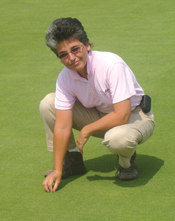
Interview with
Monica M. Lalinde
|
CAREERS IN GOLF
Interview by Nancy Berkley
Ever wondered who makes sure the grass is mowed and the greens are trimmed? That job belongs to the Golf Course Superintendent. Most superintendents are men. So, when we heard about Monica Cooper, a serious junior golfer who became a Superintendent, we wanted to share her story with you. Sometimes things do not go as planned. That was the case with Monica. After a serious back injury ended her dream of becoming an LPGA player, she had to find another way to stay close to the game she loves.
I know you were born in South America. Let's start there.
I was born 49 years ago in Colombia, South America, in the town of Medellin in the middle of the country. My mom and my dad both worked to raise six kids – three boys and three girls. I am the next to the youngest in age.
And when did you learn to play golf? Who taught and encouraged you?
It wasn't until I was 15 that I was introduced to the game by a friend of my parents. I was pretty much self-taught, especially in the beginning. When my mom saw that I was really into it, she arranged lessons with the local professional.
I know that 15 may sound a little old to take up golf by today's standards, but I believe passion and effort really determine one’s success. In my case, I got hooked right away and was playing to a 7 handicap.
What brought you to the United States?
I seriously considered staying in Columbia for college. But at the time, my older sister, who had left Colombia and settled in Tennessee, invited me to come to the US and spend time with her. I enrolled at a nearby community college – Walters State Community College in Morristown, Tennessee – to work on my English. Before I knew it, I was enrolled full-time in the Environmental Health Technology program, which I thought had something to do with working outdoors. It really didn't. Luckily, I later found out that Walters offered Turfgrass Management, which was about golf course maintenance. That would turn out to be very important.
What is Turfgrass Management?
Many sports are played on grass or turf and many colleges (like Clemson and Penn State) offer turfgrass majors with specialties in golf course management. The Golf Course Superintendents Association of America (GCSAA) offers a helpful college guide that lists over 100 universities/colleges that offer golf course management programs. http://www.gcsaa.org/students/CollegeGuideSearch.aspx
You were playing golf in college and then the bottom dropped out. Tell us what happened.
At the time, I was playing on the Walters College golf team. I thought that if I practiced hard and kept improving my game, I had a chance to play on the LPGA tour. I was practicing every day and gaining the consistency I needed.
Then the injury happened. I woke up and I could not feel my legs. I was very scared because I did not know what was wrong with me I went to the doctor and he told me that I had pinched nerves and other things wrong with my back. The best chance of recovery was to give up golf. I was devastated but the fear of being unable to walk was greater than my desire to play a professional sport.
When I realized I would not play golf professionally, I decided to major in Turfgrass Management. I transferred my passion for playing the game into taking care of the grounds on which the game is played. Staying connected to gold definitely helped me deal with my injury.
In Monica's words: What Does a Golf Course Superintendent Do?
The golf course superintendent could best be described as the person who works on providing the best possible grounds on which to play the game of golf. The job includes a little bit of everything; agronomy, business, personnel management, mechanics, water management, golf rules, and equipment management, among other things. The profession changes everyday and one must change with it or become obsolete in a hurry.
There are no two days that are alike, especially when dealing with Mother Nature and human beings in the same scenario. For me, a day at the golf course usually includes some combination of making sure that all the employees are at work, changing cups, moving tees, raking bunkers, mowing greens, patrolling for damage on the playing surfaces, checking that the irrigation system operates properly and that the different grasses are growing well. And also I have to interact with the public – our golfers and the town that owns the course.
After graduation, what jobs did you have?
I started at the bottom as a laborer-groundskeeper at the Country Club in Morristown, Tennessee. After working at several other courses, I was fortunate to be hired at the Smyrna Municipal Golf Course where I have been the Golf Course Superintendent for ten years. We have an 18-hole golf course and a 9-hole golf course that hosts a First Tee chapter. Most readers probably haven't heard of Smyrna, but it is not far from Nashville and was recently rated by US News & World Report as one of the top ten communities in which to retire in the country.
Is it hard to be in an occupation where there are so few women?
There are almost three hundred female superintendents, but most of the thousands of superintendents are male. But the truth is, male or female, you have to prove yourself in every field. Your work ethic and life goals are going to determine what you achieve. I do work very closely every day with one very important woman: Mother Nature. No matter what I know or what I do, I am at her mercy. She is the boss and I need to make the best of what she gives me.
On the personal side, tell us a little more about yourself.
I am a very reserved and shy person. At the same time, I am an over achiever. I try to do my best at everything. The hardest thing for me is dealing with people. I do not like conflict and I will go way out of my way to make everybody happy.
I have one daughter and I love spending time with her. She is not a golfer even though she has been going with me to the golf course since she was 6-weeks-old. She tried golf and played a little but never really liked it. She preferred looking at the trees, the grass and the wildlife.
What advice do you have for our readers?
I would encourage anybody to learn golf because it is so much like life; the more you put into it the more you get out of it. But, I also think that today's junior golfers have to make sure that they get on a good physical conditioning program to help them to avoid unnecessary injuries down the road.
Golf taught me that nothing comes easily. You have to be persistent if you want to achieve and even when you think you have got it, you better think again. I would encourage young girls to go for what they feel passionately about and never settle for less.
Nancy Berkley is the author of our career-interview series. She is also the Chair of the Advisory Board for Golfer Girl Magazine. Nancy has written several books about marketing golf to women and one book specifically about careers in the golf industry. For more information see www.nancyberkley.com.
|